


Answering the phone to tell a customer their brake pads have shipped is easy. Answering it 500 times a day while your knowledgeable staff is trying to close high-value transmission sales is where productivity and margins leak.
In most auto parts e-commerce businesses, phone support is a highly manual, reactive chore. Mechanics calling from noisy shops and DIYers covered in grease don't want to dig through their email for a tracking number or navigate a clunky website on their phone; they just want to call and get an answer. The result is a phone line flooded with routine status requests and stock checks that force your expert sales team to drop everything, hunt for data, and read tracking numbers out loud.
This article explores how an AI Voice Support Agent automates the entire tier-one call loop—answering inbound calls, understanding natural human speech, querying your order management system or catalog, and responding instantly so your team can focus on selling parts, not just reporting on them.
1. The Ground Reality Inside Parts E-Commerce Phone Support
When a customer wants an update, they make a fast, often impatient phone call: "Hey, I ordered a radiator yesterday, order number 98765, did that ship yet?" or "Do you guys have the master cylinder for a 2015 Tacoma in stock?"
Today, that simple call triggers a disruptive workflow. Your parts specialist stops consulting with a wholesale client. They answer the phone. They ask the customer to repeat the order number over the background noise of an air compressor. They open the ERP or Shopify dashboard. They type in the number, check the carrier integration, and read the status out loud.
Each routine call takes maybe three to five minutes. But when you are managing hundreds of daily orders, those five-minute interruptions compound into hours of lost bandwidth every single day. You are paying premium wages to automotive experts just to have them act as human order-status routers.
2. Why Traditional Voice Workflows Break at Scale
The traditional phone support process is broken because it relies on humans to handle repetitive data retrieval in real-time. As an auto parts store scales, this "human answering machine" creates a productivity tax that grows exponentially with order volume.
When you look at the raw data, the "simple phone call" is a primary driver of margin erosion:
- The 30% Time Sink: Industry benchmarks show that e-commerce support reps spend roughly 30% to 40% of their workday purely on "Where is my order?" (WISMO) and basic "Is this in stock?" queries.
- The Abandonment Gap: While a manual lookup takes a few minutes, the "hold time" (the time a customer waits in queue before reaching a rep) often averages 5 to 10 minutes during peak hours. In the auto parts industry, a 10-minute hold time often results in a hung-up phone and a lost sale to a competitor who answered faster.
- The Expertise Waste: Finding support staff who actually understand auto parts is incredibly difficult and expensive. Forcing them to answer basic logistics questions leads to rapid burnout and high turnover.
E-commerce teams try to solve this by investing in traditional "Press 1 for Orders, Press 2 for Sales" IVR (Interactive Voice Response) phone trees. However, adoption and satisfaction for robotic IVRs are abysmal. Callers "zero out" (mash the zero key) immediately to reach a human because IVRs are rigid and frustrating.
When your business relies on manual call answering, your Cost Per Call increases even as you scale. Instead of gaining efficiency, your phone lines get jammed, and your customer service scores drop exactly when your volume is highest.
3. What an AI Voice Support Agent Actually Is
An AI Voice Support Agent is an autonomous, conversational customer service layer that sits directly on your inbound phone lines.
It does not replace your expert parts advisors. Instead, it answers the phone instantly with a natural-sounding human voice, uses advanced natural language processing to understand the caller's intent (even through automotive jargon and background noise), extracts reference numbers, queries your back-end systems, and speaks the answer back to the customer. It handles all the routine calls so humans only step in when a caller needs deep technical advice or is placing a complex order.
4. How the AI Agent Works (System-Level View)
- Step 1: Instant Answering & Intent Parsing: The agent answers the call on the first ring. When the customer speaks, the AI converts the speech to text, understands the intent (e.g., order status, stock check, return policy), and extracts key identifiers like order numbers or vehicle models.
- Step 2: API & System Query: The AI securely connects to your e-commerce platform (e.g., Shopify, BigCommerce) or ERP via API. It searches for the extracted order number or SKU and pulls real-time tracking data or inventory counts.
- Step 3: Conversational Resolution: The agent formulates a natural response and speaks it back to the caller: "I found your order! The radiator for your Tacoma shipped this morning via UPS and is scheduled for delivery tomorrow by 8 PM."
- Step 4: Seamless Escalation (If Needed): If the caller asks a complex question ("Hey, does this radiator require a specific type of coolant?"), the AI instantly routes the call, along with a full transcript of the conversation, to a human parts specialist.
Free Session with Our Head of AI
30-Minute, no-strings-attached brainstorming session to identify potential bottlenecks and explore how AI can solve your business challenge.
Book Now →.png)
5. A Realistic Auto Parts Example
Consider an aftermarket performance parts retailer receiving 300 calls a day.
Before AI, the sales team receives roughly 180 calls a day just asking for shipping updates or verifying if a part on the website is actually in the warehouse. Reps spend 10 to 15 hours collectively stopping their outbound sales calls to manually search the ERP and read tracking numbers. On Monday mornings, the hold queue gets so long that 15% of callers hang up in frustration.
After implementing an AI Voice Support Agent, the workflow is revolutionized. A mechanic calls from his shop. The AI answers instantly, understands the mechanic's request for an ETA on a clutch kit, checks the system, and tells him it's out for delivery. 60% of all routine calls are handled without a human ever picking up the receiver. The sales reps reclaim hours of their day to focus on closing big-ticket orders, hold times drop to zero, and the mechanic gets his answer in 45 seconds.
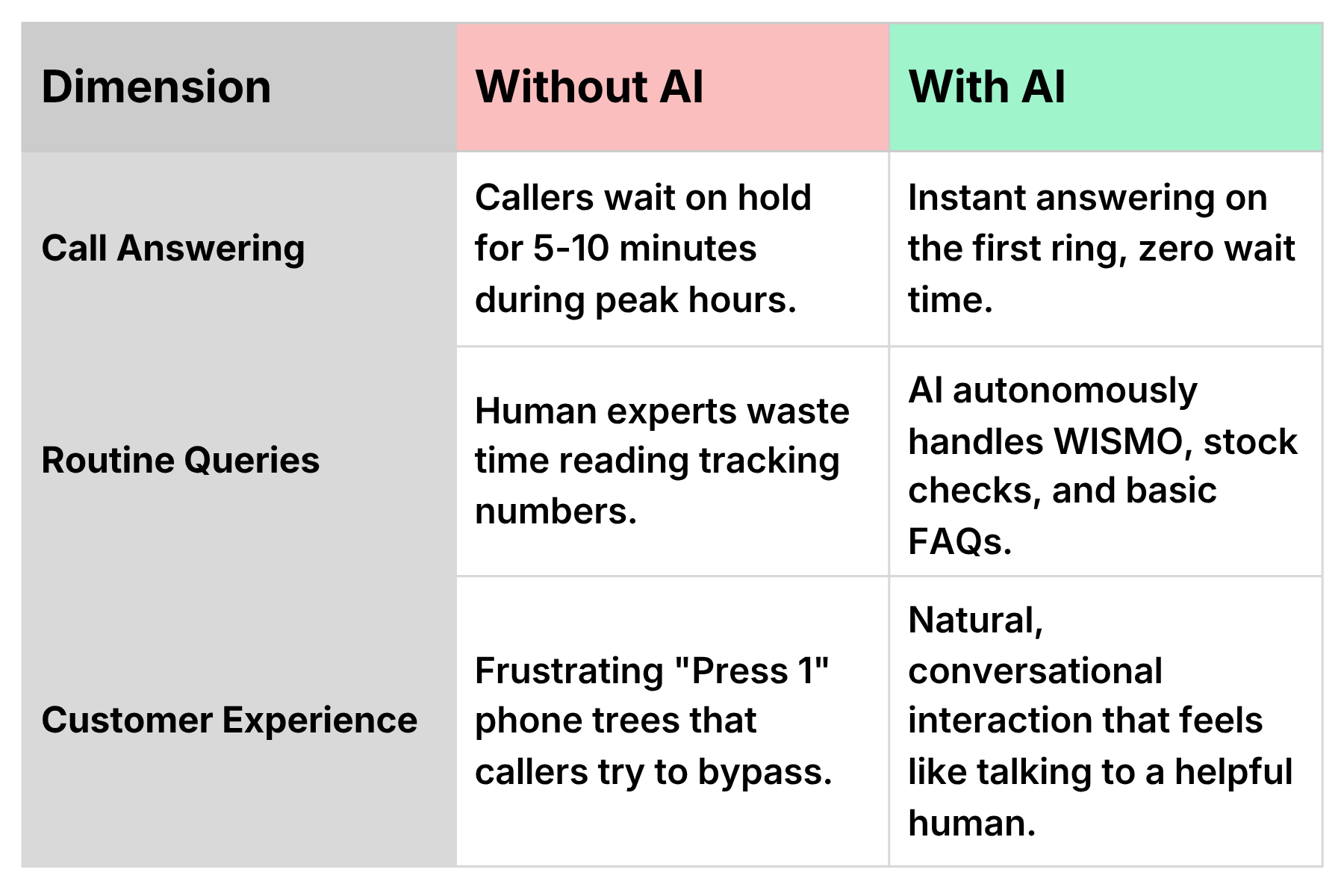
6. Before vs After: Voice AI Support Agent
7. KPIs That Move After Implementation
E-commerce teams using AI Voice Agents see an immediate spike in both operational efficiency and customer satisfaction:
- Reduced Average Handle Time (AHT) for human agents.
- Reduced Call abandonment rate (dropped calls due to long hold times).
- Increased First Call Resolution (FCR) for routine inquiries.
- Increased Human agent bandwidth for revenue-generating activities.
But the most important metric is Cost Per Resolution. When you aren't paying a $25/hour auto parts specialist to recite a FedEx tracking number, your labor costs decrease while your service capacity infinitely scales.
8. Who Should Deploy an AI Voice Agent First
This agent delivers the absolute highest ROI for B2B auto parts distributors, high-volume direct-to-consumer brands, and businesses with a high ratio of phone-in orders versus web orders. If your team is constantly bogged down by "Where is my order?" calls or you struggle to staff enough knowledgeable reps during peak season, this is the exact control layer you need to protect your payroll while providing premium, instant service.
Free Session with Our Head of AI
30-Minute, no-strings-attached brainstorming session to identify potential bottlenecks and explore how AI can solve your business challenge.
Book Now →
9. Common Objections (and Reality)
- "Our customers hate talking to robots." Customers hate bad robots—like rigid "Press 1" menus that don't understand them. Modern conversational AI sounds remarkably human, understands interruptions, and gets the caller their answer instantly. Customers prefer a helpful AI over waiting on hold for 15 minutes.
- "What if the caller has a thick accent or is in a noisy garage?" Modern Voice AI uses advanced Speech-to-Text models that are trained on diverse accents and are incredibly resilient to background noise (like air tools or highway traffic), often outperforming human hearing over a bad cellular connection.
- "Auto parts are too technical for an AI to handle." The AI is programmed with strict boundaries. It handles the logistics and basic data retrieval (stock, tracking, policies). The moment a question becomes diagnostic or highly technical, the AI's logic gate smoothly transfers the call to your human experts.
10. The Bigger Shift: From Reactive Call Centers to Proactive Sales Hubs
Traditional e-commerce workflows treat inbound phone support as a necessary, expensive evil. AI reframes voice support as an instant, scalable competitive advantage.
When your routine calls are automated, your human team is reserved strictly for high-value problem-solving and relationship building. You stop paying auto experts to be human search engines, and you start paying them to consult on builds, upsell related parts, and close deals. In the modern aftermarket industry, separating the friction of basic information retrieval from the skill of automotive sales is how you win.


.png)
.png)


.png)


Christian Financial Credit Union
Huntington National Bank
Paqqets
Meridian Medical Management
Thales Group
Meridian Medical Management