


Processing orders for aftermarket auto parts is easy. Processing the inevitable returns when a customer guesses their vehicle fitment wrong is where productivity and margins leak.
In most auto parts e-commerce businesses, part compatibility is a highly manual, reactive chore for the buyer—and a logistical nightmare for the seller. Customers do not want to cross-reference confusing fitment tables or call your support line; they just want to buy the part and fix their car. The result is a high volume of incorrect orders that force your operations team to handle costly reverse logistics, deal with angry customers, and process un-sellable open-box inventory.
This article explores how an AI Part Compatibility Validation Agent automates the entire fitment loop—reading Year/Make/Model (YMM) or Vehicle Identification Number (VIN) inputs, querying your catalog database, and validating fitment instantly so your business can focus on selling parts, not processing returns.
1. The Ground Reality Inside Parts E-Commerce
When a buyer needs a replacement part, they make a fast, uneducated guess: "This alternator looks right for my 2018 F-150." Today, that simple guess triggers a disruptive and expensive workflow. They add the part to their cart and check out. Two days later, the part arrives, and their mechanic tells them they have the 3.5L engine, but they bought the alternator for the 5.0L. The customer immediately requests a return. Your support rep has to field the frustrated email, issue an RMA (Return Merchandise Authorization), pay for return shipping, and figure out what to do with a part that can no longer be sold as brand new.
Each return might take ten to fifteen minutes of a support rep's time, plus shipping costs. But when you are processing thousands of orders a month, those individual mistakes compound into massive margin erosion every single day.
2. Why Traditional Compatibility Workflows Break at Scale
The traditional fitment process is broken because it relies on the consumer to act as a manual data-router between their vehicle's real-world specs and your complex catalog. As an auto parts store scales, this "customer guesswork" creates a profit tax that grows exponentially with order volume.
When you look at the raw data, the "simple guess" is a primary driver of margin erosion:
- The 20% Return Sink: Industry benchmarks show that auto parts e-commerce experiences return rates significantly higher than standard retail, often hovering around 20%, heavily driven by "does not fit" reasons.
- The Conversion Gap: While a confident buyer checks out in minutes, the "fitment hesitation" (the time a user spends doubting if a part will work) causes massive cart abandonment. In e-commerce, a hesitant buyer is a lost buyer.
- The Support Multiplier Effect: A single incorrect order generates multiple touchpoints: the initial support ticket, the return shipping label generation, the refund processing, and the "find the right part" exchange conversation.
E-commerce teams try to solve this by investing heavily in massive, complex fitment tables and dropdown menus on product pages. However, the adoption rate for reading the "fine print" is incredibly low. Buyers are impatient; they don't want to decipher sub-model codes or engine configurations. They live in a "click-and-buy" world, and they want you to protect them from making a mistake.
When your business relies on manual fitment checks or customer self-service, your Cost Per Acquisition increases even as you scale. Instead of gaining efficiency, you are forced to hire more support reps just to handle RMAs. Your team gets burned out playing "reverse logistics," and your profit margins drop exactly when your volume is highest.
3. What an AI Compatibility Validation Agent Actually Is
An AI Compatibility Validation Agent is an autonomous logic layer that sits directly between your product pages (or checkout cart) and your complex product catalog/database.
It does not replace your customer support team. Instead, it reads the YMM or VIN input by the user, uses data mapping to understand the exact vehicle specifications, queries your catalog for the part's fitment rules, and alerts the customer instantly. It handles all the routine fitment validation so humans only have to step in when a catalog mapping is truly broken.
4. How the AI Agent Works (System-Level View)
- Step 1: Input & Intent Parsing: The agent continuously monitors the product page or cart. When a user inputs their VIN or selects their YMM from a dropdown, the agent captures these identifiers.
- Step 2: Database Query: The AI connects to your PIM (Product Information Management) system or catalog database via API. It searches for the extracted vehicle data and pulls the exact OEM specifications required for that specific car.
- Step 3: Compatibility Verification: The agent autonomously compares the specific SKU in the user's cart against the strict fitment requirements pulled from the database.
- Step 4: Automated Customer Intervention: If there is a mismatch, the agent instantly surfaces a natural, helpful prompt: "Wait! Based on your VIN, this fuel pump doesn't fit your exact engine layout. Here is the correct fuel pump for your vehicle." It provides a one-click button to swap the item in the cart.
Free Session with Our Head of AI
30-Minute, no-strings-attached brainstorming session to identify potential bottlenecks and explore how AI can solve your business challenge.
Book Now →.png)
5. A Realistic Auto Parts Example
Consider an aftermarket retailer processing 1,000 orders a day for DIY mechanics.
Before AI, the support team receives roughly 150 emails and calls a day just asking, "Will this fit my car?" or "I ordered the wrong part, how do I return it?" RMAs cost the company thousands of dollars a week in lost shipping and depreciated open-box inventory.
After implementing an AI Compatibility Validation Agent, the workflow is invisible and proactive. A buyer adds the wrong brake pads to their cart and enters their vehicle info. Within milliseconds, the AI checks the database, blocks the incorrect purchase, and redirects them to the right pads. 80% of fitment errors are stopped without a human ever getting involved. The support reps reclaim hours of their day, and the business saves thousands in reverse logistics costs.
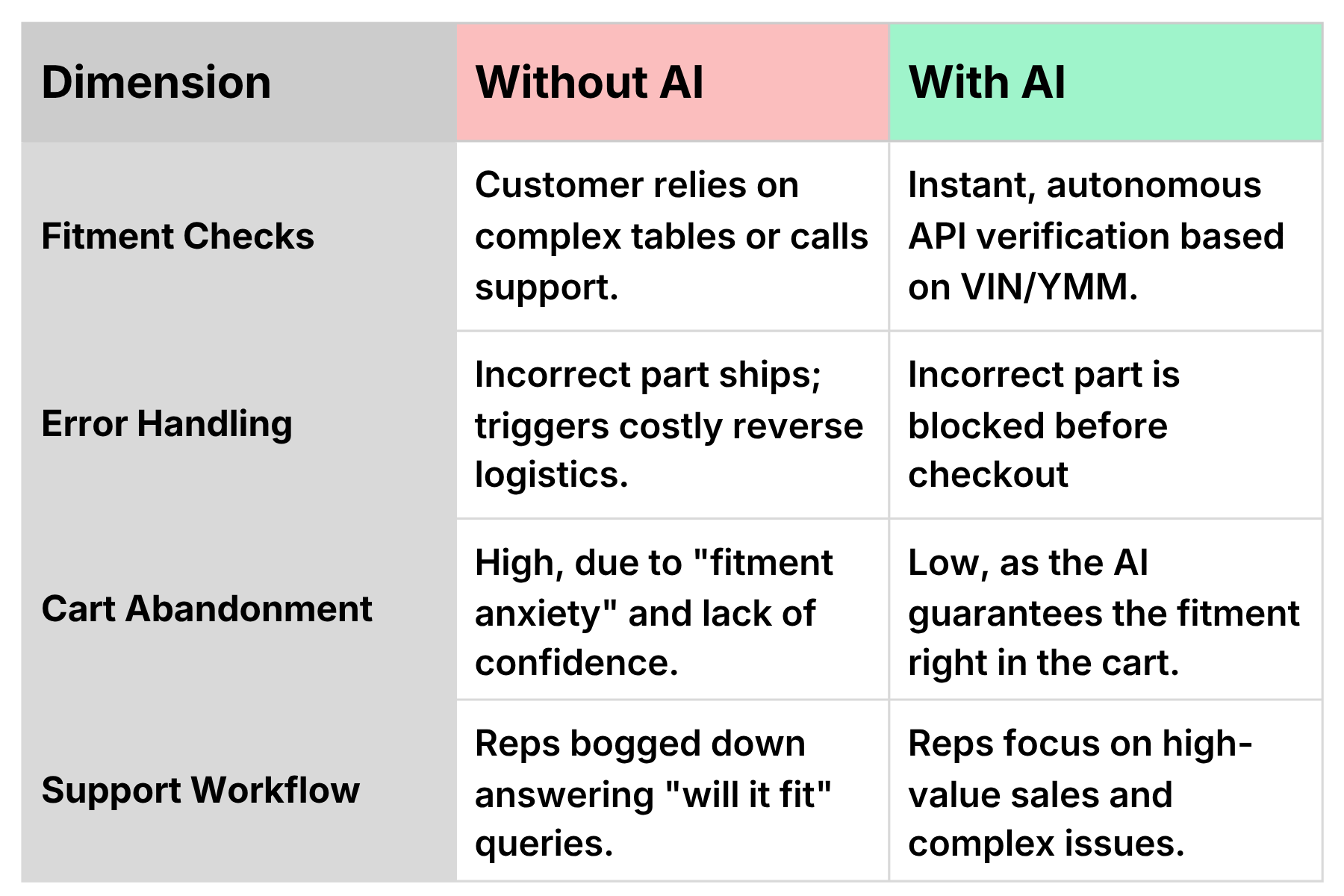
6. Before vs After: Part Compatibility AI Agent
7. KPIs That Move After Implementation
E-commerce teams using AI for fitment validation see an immediate spike in both profitability and customer satisfaction:
- Reduced Return Merchandise Authorization (RMA) rates.
- Reduced Reverse logistics and shipping costs.
- Increased Cart conversion rates.
- Increased Customer satisfaction (CSAT) and repeat purchase rates.
But the most important metric is Protected Profit Margins. When your business isn't bleeding cash on return shipping and open-box discounts, you can acquire more customers and scale your catalog without adding support headcount.
8. Who Should Deploy AI Compatibility Agents First
This agent delivers the absolute highest ROI for aftermarket auto parts retailers, B2B wholesale distributors, and dropshippers with highly complex, SKU-dense catalogs. If your business suffers from high return rates due to "wrong part ordered" or you sell highly technical components, this is the exact control layer you need to keep your margins intact while providing premium service.
Free Session with Our Head of AI
30-Minute, no-strings-attached brainstorming session to identify potential bottlenecks and explore how AI can solve your business challenge.
Book Now →
9. Common Objections (and Reality)
- "Customers won't want to enter their VIN." Buyers are highly motivated to avoid the hassle of returning a car part. When positioned as a "Fitment Guarantee" tool, adoption skyrockets. A perfectly accurate, instant check is vastly superior to the anxiety of guessing.
- "Our catalog data is too messy for an AI." Modern AI agents are excellent at mapping unstructured or messy data. They can connect fragmented PIM data with external vehicle databases to bridge the gap your legacy systems can't handle.
- "Will this slow down the checkout process?" The AI is programmed to run API calls in milliseconds. It does not introduce friction; it removes the ultimate friction of a failed order.
10. The Bigger Shift: From Reactive Returns to Proactive Guarantees
Traditional e-commerce workflows treat auto part returns as an unavoidable administrative tax. AI reframes fitment validation as an instant-service competitive advantage.
When your routine compatibility checks are automated, your human team is reserved strictly for high-value problem solving. You stop paying support professionals to process shipping labels, and you start paying them to build relationships with high-volume buyers. In the modern aftermarket industry, separating the friction of guessing from the confidence of buying is how you win.


.png)
.png)


.png)


Christian Financial Credit Union
Huntington National Bank
Paqqets
Meridian Medical Management
Thales Group
Meridian Medical Management