


Setting the right price for an aftermarket auto part is easy. Adjusting it continuously while monitoring hundreds of competitors across multiple marketplaces is where productivity and margins leak.
In most auto parts e-commerce businesses, competitor tracking is a highly manual, reactive chore. Product managers do not have the time to scour eBay, Amazon, or RockAuto every morning to see who changed their pricing; they just want to position their catalog competitively. The result is a blind spot that forces your team to find out about competitor undercuts or new product launches weeks after the damage is done—usually after a steep drop in sales.
This article explores how an AI Competitor Price & SKU Tracker Agent automates the entire market intelligence loop—monitoring competitor websites, flagging price changes and bundle offers, and alerting your team instantly so your business can focus on strategic pricing, not manual data entry.
1. The Ground Reality Inside Parts Pricing
When a competitor decides to undercut your best-selling gasket kit, they don't send you a memo. They quietly update their listing.
Today, detecting that change triggers a highly inefficient workflow. Your product manager notices sales for a specific SKU have dipped over the last two weeks. They stop their high-value sourcing work. They open a dozen browser tabs across Amazon, eBay, and direct competitor sites. They manually search for the part number, compare the prices, and realize a competitor is not only selling it 10% cheaper, but they’ve bundled it with a tube of silicone sealant.
Each manual audit takes ten to twenty minutes per SKU. But when you are managing a catalog of thousands of aftermarket parts, those manual checks are impossible to scale. You are always playing defense, and you are always late.
2. Why Traditional Pricing Workflows Break at Scale
The traditional market research process is broken because it relies on humans to act as manual web scrapers between the broader internet and your pricing strategy. As an auto parts store scales its catalog, this "human middleware" creates a latency gap that grows exponentially with SKU count.
When you look at the raw data, manual tracking is a primary driver of margin erosion:
- The Revenue Leakage: Industry benchmarks show that losing the "Buy Box" or being significantly undercut on high-volume replacement parts can cause a 40% to 60% drop in sales for that specific SKU almost overnight.
- The Latency Gap: While a manual price check takes a human a few minutes, the "discovery lag" (the time between a competitor changing a price and your team noticing) averages weeks. In e-commerce, a two-week-old price adjustment means you've already lost the month's revenue target for that part.
- The Multiplier Effect: A single vehicle application might have dozens of cross-compatible SKUs sold by hundreds of different vendors. For a catalog of 10,000 parts, continuous manual monitoring is a mathematical impossibility.
E-commerce teams try to solve this by randomly sampling their top-selling products once a month. However, competitors are using dynamic pricing tools. By the time your team updates your spreadsheet, the market has already shifted.
When your business relies on manual competitor tracking, your revenue drops exactly when the market gets aggressive. Instead of gaining market share, your product managers get burned out playing "find the lowest price," and your margins suffer.
3. What an AI Competitor Tracking Agent Actually Is
An AI Competitor Price & SKU Tracker Agent is an autonomous intelligence layer that sits directly between the wider e-commerce ecosystem (eBay, Amazon, competitor sites) and your product management team.
It does not replace your pricing strategists or product managers. Instead, it continuously monitors target websites, uses computer vision and natural language processing to extract pricing data, stock statuses, and new product launches, and compiles actionable alerts. It handles the exhausting reconnaissance work so humans only have to step in to make strategic pricing decisions.
4. How the AI Agent Works (System-Level View)
- Step 1: Multi-Channel Monitoring: The agent continuously scans predefined competitor URLs, marketplace search results, and brand pages.
- Step 2: Data Extraction & Normalization: The AI extracts the unstructured data from the competitor's page—identifying the part number, current price, shipping costs, stock status, and any bundled items. It normalizes this data to match your internal SKUs.
- Step 3: Anomaly & Trend Detection: The agent autonomously compares the newly scraped data against your current pricing and historical competitor data. It looks for specific triggers: a price drop of more than 5%, a new product launch, or a competitor going out of stock.
- Step 4: Automated Alerting: The agent drafts a concise weekly digest (or real-time Slack alert for VIP SKUs): "Alert: Competitor X has launched a bundled Gasket Kit + Sealant at a 10% lower price point. Recommendation: Adjust promo pricing or match bundle." ### 5. A Realistic Auto Parts Example
Free Session with Our Head of AI
30-Minute, no-strings-attached brainstorming session to identify potential bottlenecks and explore how AI can solve your business challenge.
Book Now →.png)
5. A Realistic Auto Parts Example
Consider an aftermarket retailer managing a catalog of 5,000 SKUs, heavily reliant on marketplace sales.
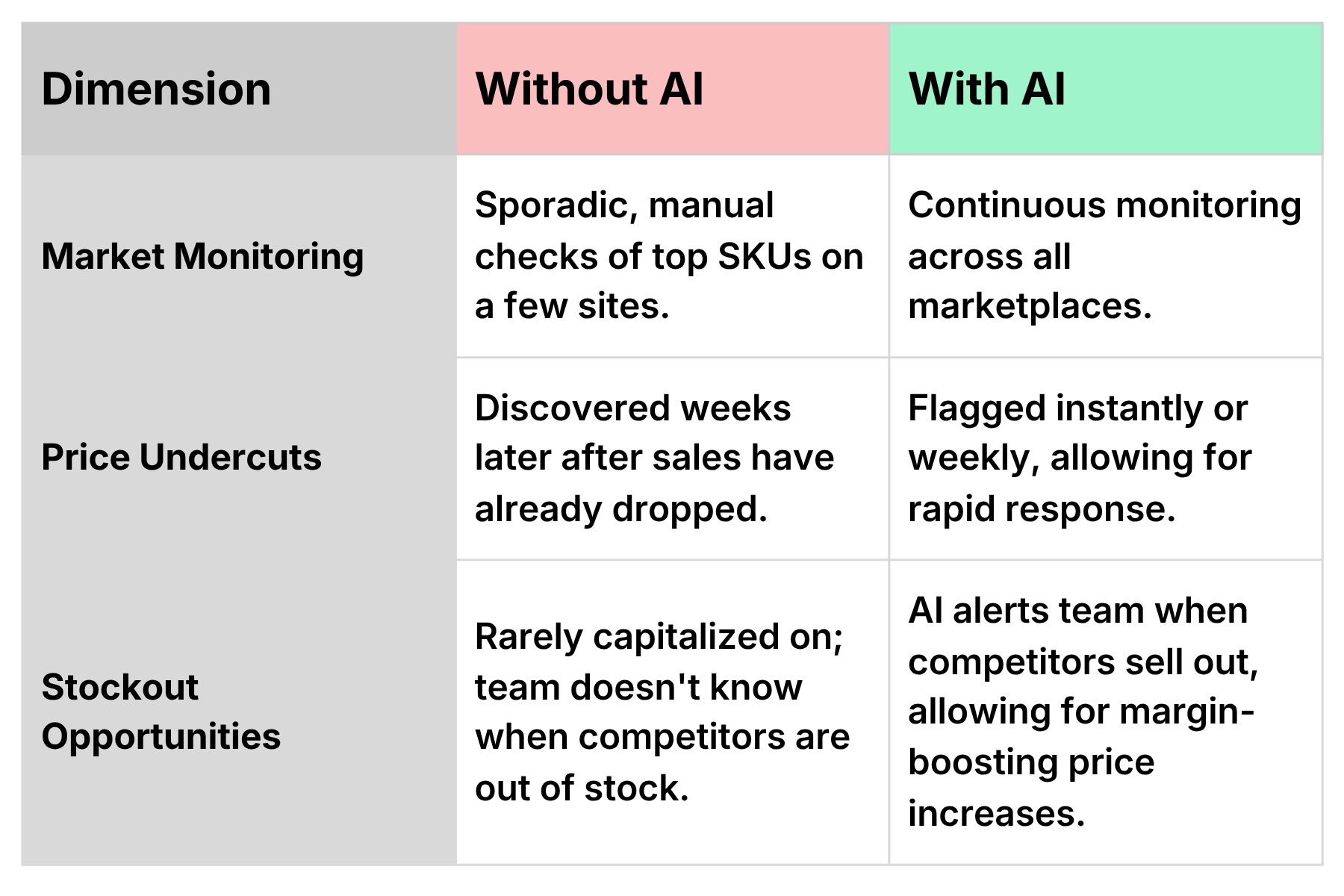
Before AI, the product team operates mostly in the dark. They manually check the top 50 SKUs every Friday. On a Tuesday, a major competitor drops the price of a high-volume brake rotor by 15%. For the next ten days, the retailer's sales flatline on that item. By the time the PM discovers the undercut during their manual check, thousands of dollars in revenue have been lost to the competitor.
After implementing an AI Competitor Tracking Agent, the workflow is proactive. The competitor drops their price on Tuesday at 9:00 AM. By 9:15 AM, the AI agent flags the 15% drop and sends a direct alert to the PM. The PM immediately reacts with a targeted promotion to match the price. The retailer stops the revenue bleed instantly. Furthermore, the agent notes when the competitor runs out of stock, allowing the PM to temporarily raise prices to maximize margins when they are the only seller with inventory.
6. Before vs After: Competitor Tracking AI Agent
7. KPIs That Move After Implementation
E-commerce teams using AI for competitor tracking see an immediate spike in both market responsiveness and catalog profitability:
- Reduced Revenue leakage from undetected competitor undercuts.
- Reduced Hours spent on manual market research and data entry.
- Increased Buy Box win rates on marketplaces like Amazon and eBay.
- Increased Profit margins (by identifying competitor stockouts and raising prices).
But the most important metric is Speed to Insight. When your team isn't acting as a human web scraper, they can react to market shifts in minutes rather than weeks, keeping your brand competitive in real-time.
8. Who Should Deploy AI Competitor Tracking First
This agent delivers the absolute highest ROI for aftermarket retailers, high-volume dropshippers, and brands heavily reliant on third-party marketplaces (Amazon, eBay, Walmart). If your business operates in a highly commoditized segment of the auto parts industry where a $5 price difference dictates who wins the sale, this is the exact control layer you need to protect your market share.
Free Session with Our Head of AI
30-Minute, no-strings-attached brainstorming session to identify potential bottlenecks and explore how AI can solve your business challenge.
Book Now →
9. Common Objections (and Reality)
- "We don't want to engage in a race to the bottom." AI tracking isn't just about lowering prices. It is equally about raising them. When the AI detects that your three biggest competitors are out of stock on a specific fuel injector, you can confidently raise your price, knowing buyers have no other options.
- "Competitor websites block scrapers." Traditional hard-coded scrapers break easily. Modern AI agents use sophisticated, headless browsing and visual interpretation that can read a webpage exactly like a human does, bypassing traditional scraper blocks.
- "We have too many SKUs; the data will be overwhelming." The AI is programmed with logic gates. It doesn't alert you every time a price changes by two cents. You set the thresholds (e.g., "Only alert me if a top-100 SKU price drops by more than 5% or a new competitor enters the listing"), keeping the insights highly actionable.
10. The Bigger Shift: From Reactive Deficits to Proactive Dominance
Traditional e-commerce workflows treat market research as a tedious, periodic administrative tax. AI reframes competitor tracking as an instant, proactive competitive advantage.
When your routine market intelligence is automated, your human team is reserved strictly for high-value strategic maneuvering. You stop paying product managers to copy and paste prices from RockAuto, and you start paying them to outmaneuver the competition. In the modern aftermarket industry, separating the friction of data gathering from the skill of pricing strategy is how you win.


.png)
.png)


.png)


Christian Financial Credit Union
Huntington National Bank
Paqqets
Meridian Medical Management
Thales Group
Meridian Medical Management