


Getting a quote request in your inbox is a win. Chasing down the missing pallet dimensions over three days of emails is where margin and win rates die.
In most freight brokerages and 3PLs, the order intake process is a highly manual game of ping-pong. Customers email vague requests, and your pricing team has to stop what they are doing to reply and ask for the missing details. The quote eventually gets built—but rarely fast enough to beat the competition.
This article explores how an AI Order Intake and Quote Generation Agent automates the entire front-end of the quoting process, connecting your inbox to your TMS so your team only steps in to review the final numbers and close the deal.
1. The Ground Reality Inside Order Intake
When a shipper needs a truck, they rarely provide perfect information on the first try. A typical inbound email looks like this: "Need a van from Chicago to Dallas next Tuesday. Let me know the rate."
To actually build the quote, your rep needs the origin city, destination city, exact dates, weight, pallet count, and commodity type. So, the rep replies asking for the weight. The customer replies two hours later. The rep replies asking if it's palletized or floor-loaded. The customer replies the next morning.
By the time the rep has enough information to log into the Transportation Management System (TMS) and pull a rate, 24 hours have passed. In logistics, the first to quote usually wins the freight. If you are playing email ping-pong, you are losing the load.
2. Why Traditional Quoting Workflows Break at Scale
The traditional quote-to-book process is broken because it forces high-value brokers to act as low-value data collectors. When your team spends their morning chasing dimensions instead of negotiating rates, your "Speed to Quote" suffers—and in this industry, speed is the only sustainable competitive advantage.
The data reveals that manual order intake is a silent killer of brokerage margins:
- The 30-Minute Rule: Statistics show that the "First-to-Quote" broker wins the load over 60% of the time. If your manual back-and-forth takes two hours, your probability of winning that freight has already dropped by half.
- The "Context Switching" Tax: It takes an average of 23 minutes for a human to regain deep focus after being interrupted by a "quick" email check. A rep managing 50 "vague" quote requests a day is effectively operating at 30% cognitive capacity.
- The 40% Information Gap: Roughly 40% of inbound quote requests in a typical inbox are "incomplete" (missing weight, dimensions, or exact zip codes). This triggers a manual "ping-pong" loop that extends the sales cycle from minutes to hours—or even days.
When order volumes spike, human reps naturally hit a ceiling. They begin to "cherry-pick"—prioritizing easy, complete requests from top-tier clients while ignoring the "messy" or incomplete emails from mid-market prospects. This creates a dark funnel of lost revenue where thousands of dollars in potential margin sit untouched in the inbox simply because the rep didn't have 90 seconds to ask for a pallet count.
Without AI, your ability to grow is tied directly to your headcount. To double your quote volume, you traditionally have to double your operations staff. This linear scaling kills your Operating Leverage. An AI-driven intake layer breaks this link, allowing you to triple your quote output without adding a single dollar to your fixed labor costs.
3. What an AI Order Intake and Quote Generation Agent Actually Is
It is an autonomous communication and data-routing layer that sits between your customer-facing inbox and your TMS.
It does not replace your pricing reps or dispatchers. Instead, it reads the inbound emails, identifies exactly what information is missing, and politely replies to the customer to gather it. Once it has the complete picture (origin, destination, dates, materials), it queries your TMS for the rate, drafts the final email, and pings your human team to review and hit "send."
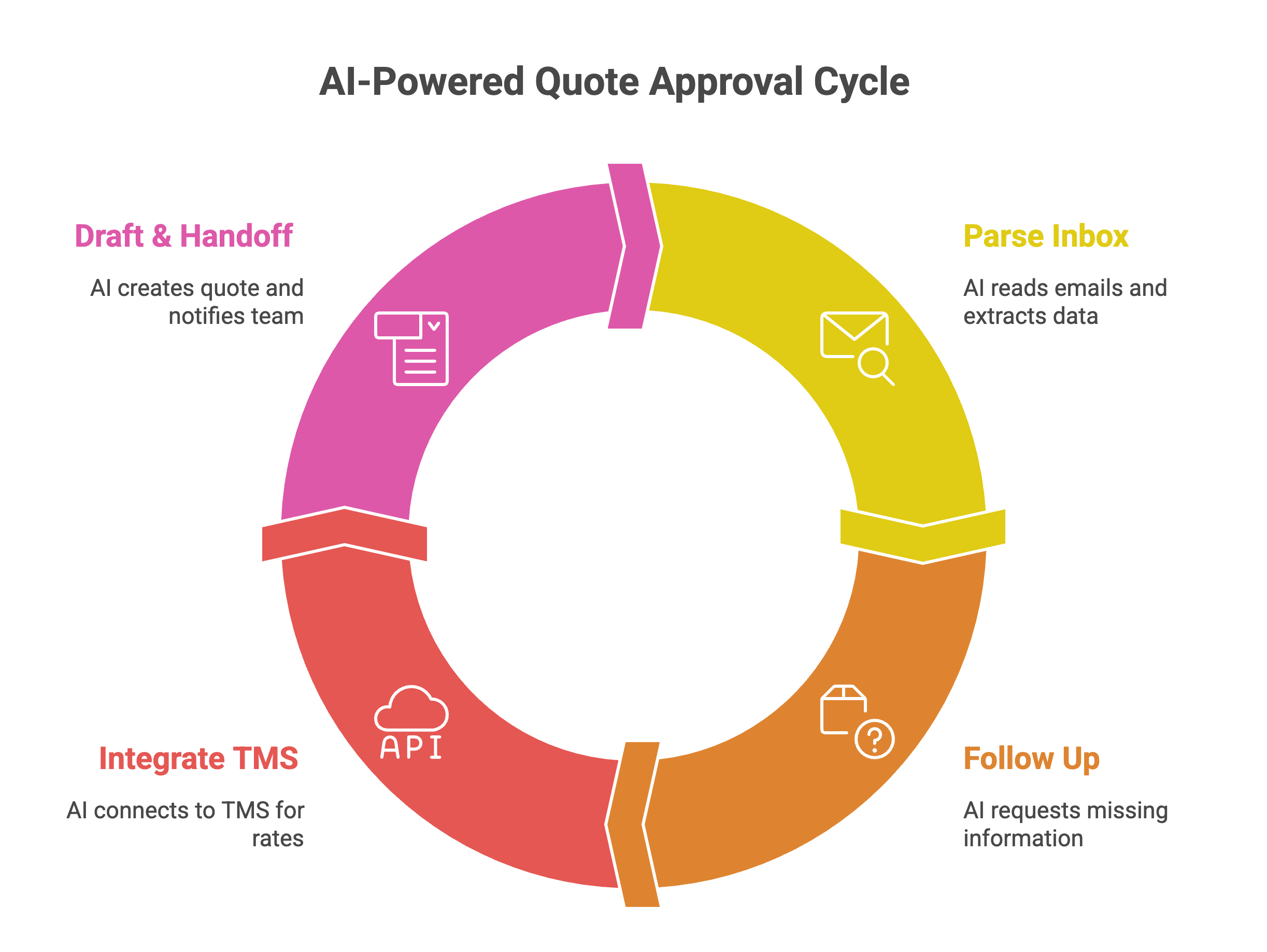
4. How the AI Agent Works (System-Level View)
- Step 1: Inbox Parsing & Intent Recognition: The agent monitors the quote request inbox. It uses Natural Language Processing (NLP) to read the email and extract the provided entities (e.g., Chicago to Dallas, next Tuesday).
- Step 2: Autonomous Follow-Up: The AI cross-references the extracted data against your required quote fields. If the weight and commodity are missing, the agent instantly replies to the customer: "Happy to get you a rate for Chicago to Dallas on Tuesday. Could you please confirm the total weight and what materials we are hauling?"
- Step 3: TMS Integration: Once the customer replies and all data is secured, the agent connects directly to your TMS via API. It inputs the origin, destination, dates, and equipment type to retrieve the current market rate or contracted pricing.
- Step 4: Draft & Handoff: The AI drafts a perfectly formatted reply to the customer containing the quote. It saves it as a draft and sends a Slack or system notification to the human orders team: "Quote ready for review: Chicago to Dallas. TMS suggests $1,850." The human reviews, adjusts the margin if needed, and hits send.
Free Session with Our Head of AI
30-Minute, no-strings-attached brainstorming session to identify potential bottlenecks and explore how AI can solve your business challenge.
Book Now →.png)
5. A Realistic Logistics Example
Consider a mid-sized freight broker processing 200 quote requests a day.
Before AI, the pricing team spends roughly 3 to 4 hours every single day just replying to emails to ask for missing dimensions, weights, or pickup times. Quote turnaround time averages 4 hours. Because they are slow to respond, their win rate on spot freight hovers around 12%.
After implementing an AI Order Intake Agent, the messy back-and-forth disappears from the reps' workload. The AI handles the data gathering in minutes. When the rep opens the ticket, all the details are perfectly organized, and the TMS rate is already sitting in the draft. Quote turnaround time drops to 15 minutes. Because they are consistently the first to reply with a complete rate, their spot win rate jumps to 22%.
6. Before vs After: Quote Generation

7. KPIs That Move After Implementation
Logistics teams using AI for order intake see immediate improvements in speed and capacity:
- Reduced Average quote turnaround time
- Less Hours spent on inbox management
- Increased Quote-to-win ratio (Win Rate)
- High Number of quotes processed per rep per day
But the most important metric is Revenue per Rep. When your team stops doing administrative data collection, they can quote double the volume and focus purely on margin strategy.
8. Who Should Deploy AI Order Intake First
This agent delivers the absolute highest ROI for freight brokers, 3PLs, and asset-based carriers that deal with high volumes of spot market quotes or direct shipper emails. If your operations team complains that they can't keep up with the inbox, or if you know you are losing freight simply because you aren't quoting fast enough, this is the exact system you need.
Free Session with Our Head of AI
30-Minute, no-strings-attached brainstorming session to identify potential bottlenecks and explore how AI can solve your business challenge.
Book Now →
9. Common Objections (and Reality)
- "Our customers want a human touch, not a bot." Customers want a fast, accurate rate. An immediate, polite email asking for the missing pallet weight provides a vastly superior customer experience than a human rep ignoring the email for three hours because they are busy.
- "What if the TMS rate is off?" That is exactly why the AI does not hit send. It saves the quote as a draft. The human rep remains the final set of eyes to adjust the margin or fix the rate before it goes to the customer.
- "Every customer formats their emails differently." AI doesn't rely on rigid templates. Large Language Models (LLMs) can read unstructured text—whether it's a messy paragraph or a forwarded thread—and extract the core logistics data perfectly.
10. The Bigger Shift: From Reactive Data Entry to Proactive Sales
Traditional logistics workflows treat order intake as a manual, reactive chore. AI reframes it as an automated, high-speed data pipeline.
When your quoting process is instant and frictionless, your agency becomes the easiest broker or carrier to do business with. The goal is not just to automate an email; it is to dominate the spot market with speed. In logistics, separating the friction of data collection from the skill of pricing is how you scale your book of business without scaling your headcount.


.png)
.png)
.png)


Christian Financial Credit Union
Huntington National Bank
Paqqets
Meridian Medical Management
Thales Group
Meridian Medical Management