


Receiving an invoice is easy. Getting the data out of a messy PDF and into your system without bleeding margin is the real challenge.
In many operations, especially those dealing with international shippers, billing doesn't happen neatly through EDI or API connections. It happens via email attachments. PDFs, scanned documents, and varying formats flood the inbox, forcing your accounts payable (AP) team to manually key line items into the Transportation Management System (TMS).
This article explores how an AI Invoice Processing Agent automates the handling of non-electronic invoices—reading emails, extracting complex order details, and injecting the data directly into your TMS so your team can stop typing and start analyzing.
If your back office is trapped in an endless cycle of manual data entry just to keep the carriers paid and the books closed, this blog explains where the inefficiency lives—and how AI fixes it.
1. The Ground Reality Inside Invoice Processing
When working with international shippers or smaller regional carriers, standardization doesn't exist. Every company has its own invoice layout.
Today, the workflow looks like this:
An email arrives with a PDF attached.
An AP clerk opens the email.
They open the PDF on one monitor and the TMS on the other.
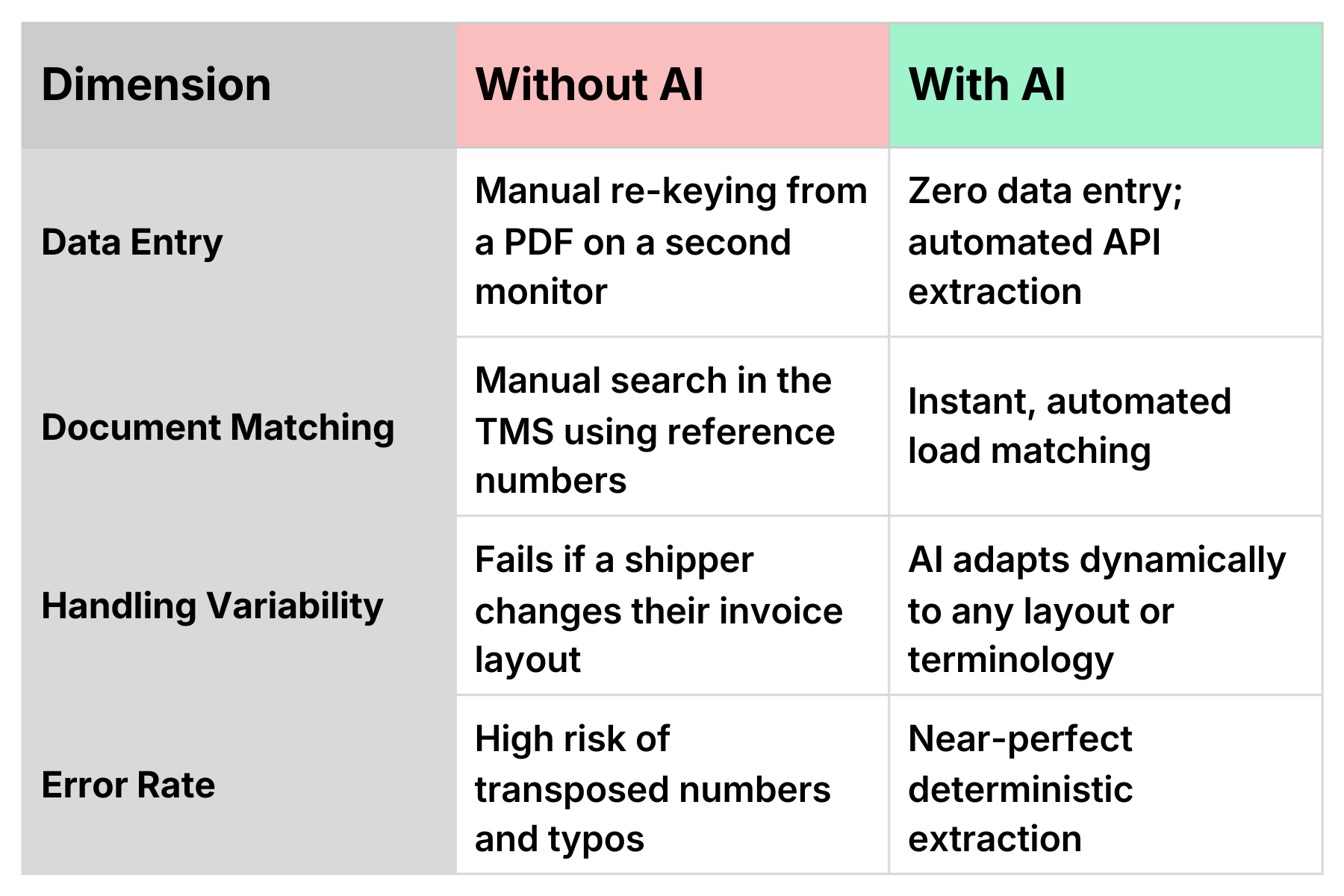
They manually hunt for the load reference number to match the invoice to the correct shipment.
They manually re-key the origin, destination, line-haul charges, fuel surcharges, accessorials, and total amounts.
They hit save.
Then, they move to the next email.
2. Why Traditional Invoice Processing Breaks at Scale
The traditional AP process is broken because humans are acting as expensive, slow-motion OCR scanners. In a high-volume brokerage, this manual "human-in-the-loop" requirement creates a structural bottleneck that prevents true scaling.
When you move from 100 to 1,000 invoices a week, the cracks in the manual workflow become craters:
- The $15-Per-Invoice Burden: Industry studies show that manually processing a single paper or PDF invoice costs an average of $12 to $22 when factoring in labor, routing, and overhead. For a 3PL processing 2,000 invoices a month, that’s a $30,000+ monthly tax on operations.
- The 3% Error Rate: Human data entry carries an average error rate of 1% to 3%. In logistics, a single transposed digit—turning a $1,200 line-haul into $2,100—can wipe out the entire margin of five other loads before the mistake is even caught.
- The Processing Lag: A manual invoice takes an average of 8.2 days to clear the "received-to-approved" cycle. This delay prevents real-time financial visibility and forces your finance team to operate on "estimated" rather than "actual" margins.
Many firms try to solve this with legacy OCR software, but they quickly hit the 80/20 Wall. Traditional OCR relies on rigid templates; if a carrier changes their font or moves the "Fuel Surcharge" box three inches to the left, the system breaks. This leaves your team managing "software exceptions" instead of actually processing freight.
When your business relies on manual typing, you aren't just slowing down your payment cycles; you are introducing structural financial risk. Scaling your freight volume shouldn't mean linearly scaling your back-office headcount. Without AI, your G&A (General and Administrative) expenses grow at the same rate as your revenue, effectively capping your profitability.
3. What an AI Invoice Processing Agent Actually Is
An AI Invoice Processing Agent is an autonomous data extraction and routing layer. It sits between your AP inbox and your TMS.
It does not replace your finance team. Instead, it acts as a digital clerk that never sleeps. It reads the incoming email, opens the non-electronic attachment, uses AI vision to understand the document’s context—regardless of the layout—and pushes perfectly structured data directly into the TMS via API.
4. How the AI Agent Works (System-Level View)
- Step 1: Inbox Ingestion: The agent continuously monitors a designated inbox (e.g., invoices@yourbrokerage.com). When an email with an attachment arrives, it strips the PDF or image file for processing.
- Step 2: Contextual Extraction: Unlike legacy OCR that relies on rigid, easily broken templates, the AI uses Large Language Models (LLMs) with vision capabilities. It understands what a fuel surcharge is, even if one shipper calls it "FSC" and another calls it "Fuel Fee." It extracts the line items, dates, amounts, and reference numbers.
- Step 3: TMS Matching & Validation: The agent queries your TMS via API to find the corresponding load. It validates the extracted invoice total against the expected accrued cost in the system.
- Step 4: Autonomous Entry & Routing: If the invoice matches the expected cost within a defined tolerance, the agent injects the data into the TMS, attaches the original PDF to the load file, and approves it for payment. If there is a massive discrepancy, it routes the invoice to a human for exception handling.
Free Session with Our Head of AI
30-Minute, no-strings-attached brainstorming session to identify potential bottlenecks and explore how AI can solve your business challenge.
Book Now →.png)
5. A Realistic Logistics Example
Consider a 3PL or freight brokerage processing 500 international and non-EDI invoices a week.
Before AI, the AP team spends roughly 5 minutes per invoice opening emails, matching loads, and typing in line items. That is over 40 hours a week of pure data entry. Month-end closing is a nightmare of reconciliation, and typo-driven overpayments constantly eat into margins.
After implementing an AI Invoice Processing Agent, the workflow is transformed. The agent processes those 500 invoices in the background as soon as they hit the inbox. 85% of them match the TMS accruals perfectly and are instantly logged and approved. The AP team spends their time investigating only the 15% of invoices that were flagged for price discrepancies. The 40 hours of data entry drops to 5 hours of strategic exception management.
6. Before vs After: Invoice Processing
7. KPIs That Move After Implementation
Logistics teams using AI for invoice processing see an immediate impact on their operational efficiency:
- Reduced AP hours spent on manual data entry
- Less Invoice processing cost per load
- Less Payment errors and reconciliation delays
- Increased Percentage of touchless invoice approvals
But the most important metric is Back-Office Scalability. When data entry is automated, you can double your load volume without hiring a single new AP clerk.
8. Who Should Deploy AI Invoice Processing First
This agent delivers the absolute highest ROI for 3PLs, freight brokers, and high-volume logistics teams that manage a fragmented carrier base, deal with international freight forwarders, or receive a massive volume of emailed PDF invoices. If your finance team is buried in attachments at the end of every month, this is the control layer you need.
Free Session with Our Head of AI
30-Minute, no-strings-attached brainstorming session to identify potential bottlenecks and explore how AI can solve your business challenge.
Book Now →
9. Common Objections (and Reality)
- "Our international shippers use completely different layouts and languages." Modern AI doesn't use templates. It reads contextually. It can identify a line-haul charge whether the invoice is formatted cleanly from a massive carrier or generated on an Excel spreadsheet by a single owner-operator.
- "What if the AI reads a number wrong?" The AI operates with confidence scores. If a scan is blurry or a number is illegible, the system does not guess. It routes that specific document to a human queue for review.
- "This sounds like it will replace my AP team." It replaces the typing, not the team. Your AP staff shifts from doing data entry to handling real financial discrepancies and managing carrier relationships.
10. The Bigger Shift: From Data Entry to Margin Protection
Traditional logistics workflows treat AP as a back-office cost center burdened by paperwork. AI reframes it as a high-speed, automated financial pipeline.
When your invoice processing is frictionless, your team catches billing errors before they are paid, month-end closes happen faster, and your operational data is perfectly accurate. In logistics, separating the friction of typing from the skill of financial analysis is how you build a resilient, scalable business.


.png)
.png)
.png)


Christian Financial Credit Union
Huntington National Bank
Paqqets
Meridian Medical Management
Thales Group
Meridian Medical Management