


Assigning loads is easy. Assigning them well is where profit leaks.
In many logistics operations, dispatchers still rely on spreadsheets, tribal knowledge, and rapid phone calls to match shipments with available trucks.
Loads get covered — but not optimally.
This article explores how an AI Load-to-Vehicle Matching agent automates load planning to maximize cube and weight utilization, reduce empty miles, and turn dispatching from a firefight into a system.
Free Session with Our Head of AI
30-Minute, no-strings-attached brainstorming session to identify potential bottlenecks and explore how AI can solve your business challenge.
Book Now →.png)
If your trucks are moving but margins still feel thin, this blog explains where the inefficiency actually happens — and how AI fixes it.
1. Covering Loads Is Not the Same as Optimizing Them
Most dispatch days start with the same assumption:
“If every shipment is assigned, we’ve done our job.”
In reality, that’s only the beginning.
The most expensive mistakes don’t come from uncovered loads.
They come from poor load combinations.
That critical moment happens when:
- Shipments are reviewed in isolation
- Availability is checked across multiple sheets
- Dispatchers juggle calls and ETA pressure
- Decisions are made quickly to “keep freight moving”
This is where inefficiency quietly enters the system.
2. The Hidden Cost of Manual Load Planning
On a typical day, dispatchers must consider:
- Shipment origins and destinations
- Weight and cube constraints
- Delivery windows
- Equipment type
- Driver hours and availability
But the data rarely lives in one place.
It lives in:
- Spreadsheets
- TMS screens
- Emails and texts
- Dispatcher memory
Under time pressure, shipments are matched one-by-one instead of as a system.

Common outcomes
- Trucks leave under-utilized
- LTL shipments that could be combined aren’t
- Routes overlap unnecessarily
- Extra trucks are dispatched “just to be safe”
None of this looks like a failure in real time.
It only shows up later as:
- Higher fuel costs
- Extra labor hours
- Missed efficiency targets
- Lower fleet ROI
3. Why Traditional Dispatch Fixes Fall Short
Operations teams often try to improve this with:
- Better spreadsheets
- More dispatcher training
- Routing rules of thumb
- Experience-based decision making
These help — but they don’t solve the core problem.
Why?
Because humans are being asked to:
- Evaluate dozens of shipments simultaneously
- Calculate cube and weight trade-offs mentally
- Optimize routes under time pressure
- Do this repeatedly, all day
This isn’t a skill issue.
It’s a combinatorial optimization problem.
4. What an AI Load-to-Vehicle Matcher Actually Is
An AI Load-to-Vehicle Matching agent is a system that:
- Ingests all shipments scheduled for dispatch
- Ingests all available vehicles and constraints
- Evaluates thousands of possible combinations
- Optimizes for utilization, distance, and time
- Produces clear, actionable load plans
It doesn’t replace dispatchers.
It removes the need for guesswork.
5. How the AI Works (Step-by-Step)
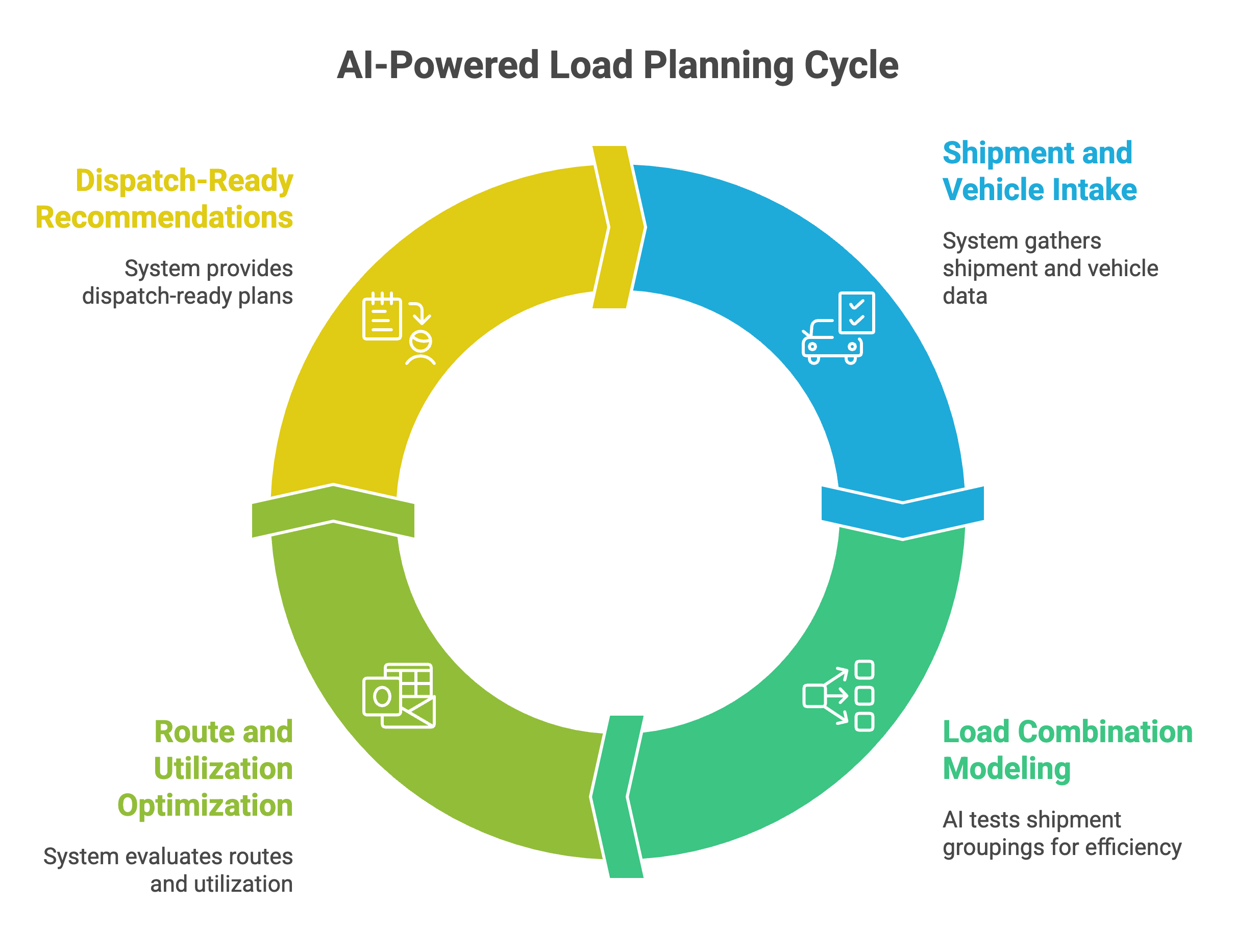
Step 1: Shipment and vehicle intake
The system pulls:
- Shipment origins, destinations, and windows
- Weight, cube, and special handling needs
- Available trucks, capacities, and driver limits
Everything is evaluated together, not sequentially.
Step 2: Load combination modeling
The AI tests thousands of possible shipment groupings to answer:
- Which loads can be combined without breaking constraints?
- What combinations maximize cube and weight fill?
- Which routes minimize total miles and drive time?
This is impossible to do manually at scale.
Step 3: Route and utilization optimization
For each viable combination, the system evaluates:
- Total distance traveled
- Empty miles introduced or eliminated
- Estimated driving and dwell time
- On-time delivery feasibility
Only feasible, compliant plans move forward.
Step 4: Dispatch-ready recommendations
The output is not abstract math.
Dispatchers receive:
- Suggested truck assignments
- Clearly grouped shipments per vehicle
- Optimized routes
- Utilization and efficiency indicators
Plans can be accepted, adjusted, or overridden.
Free Session with Our Head of AI
30-Minute, no-strings-attached brainstorming session to identify potential bottlenecks and explore how AI can solve your business challenge.
Book Now →
6. End-to-End Example: What Changes in Practice
Without AI (common reality)
- 27 LTL shipments leaving Houston
- Shipments reviewed one-by-one
- 7 trucks dispatched to cover them
- Overlapping routes and partial fills
- Extra driver hours and fuel usage
Loads are covered.
Efficiency is left on the table.
With AI Load-to-Vehicle Matching
- All 27 shipments evaluated together
- 12 shipments intelligently grouped
- Shipped on just 3 optimized trucks
- 4 hours and 90 miles eliminated
- Higher utilization with fewer trips
Same freight.
Very different outcome.
7. Before vs After: The Difference Is Structural
The biggest change isn’t speed.
It’s system-level optimization instead of individual judgment.
AI ensures that every dispatch decision is made with full visibility across all loads and vehicles — every time.

8. KPIs That Improve Immediately
Teams using AI load matching see improvements in:
- Fewer total trips
- Lower fuel and labor costs
- Better cube and weight utilization
- Higher OTIF and SLA compliance
But the most important metric is this:
Freight moved per truck per day
That’s where fleet ROI is decided.
9. Who This Delivers the Most Value For
This use case delivers the highest ROI for:
- Fleets handling high daily shipment volumes
- LTL and mixed-load operations
- Dispatch teams managing constant time pressure
- Operations struggling with empty or partial trucks
If your team says:
“We’re busy all day, but trucks still leave half full”
This is built for you.
10. Common Objections (Answered)
“Our dispatchers already optimize well”
They optimize based on what they can see — not all possible combinations.
“This sounds complex”
So is load planning at scale.
AI handles the complexity so dispatchers don’t have to.
“We don’t want to lose control”
AI recommends.
Humans decide.
Control stays exactly where it belongs.
Free Session with Our Head of AI
30-Minute, no-strings-attached brainstorming session to identify potential bottlenecks and explore how AI can solve your business challenge.
Book Now →
11. The Bigger Picture: Capacity Is Lost in Planning
Most fleet inefficiency happens:
- Not on the road
- Not because of drivers
- But during planning
AI ensures capacity is used intentionally, not incidentally.
Final Takeaway
Dispatching isn’t about moving freight.
It’s about moving the right freight together.
AI Load-to-Vehicle Matching doesn’t add more trucks.
It helps you get more value from the ones you already have.
And in logistics, that’s where real efficiency — and real margin — lives.
Our team helps high-volume logistics organizations reduce empty miles, improve utilization, and increase fleet ROI using AI.
If AI implementation is on your radar this year, explore how we help and other high-ROI use cases here:
https://symphonize.com/logistics-ai


.png)
.png)


Christian Financial Credit Union
Huntington National Bank
Paqqets
Meridian Medical Management
Thales Group
Meridian Medical Management