


Winning a shipment bid doesn’t guarantee profitability — execution does.
For many logistics companies, margin erosion begins when project details are manually re-entered into the TMS under time pressure.
This article explores how AI automates the transition from bid award to TMS setup, eliminating data entry errors and ensuring what was sold is exactly what gets executed.
If you’ve ever won a project and still lost margin on it, this blog explains where that loss actually happens—and how AI prevents it.
1. Winning the Bid Is Not the Finish Line
In logistics, the most dangerous assumption is:
“We won the bid. The hard part is done.”
In reality, the highest-risk moment comes after the award.
That moment is when:
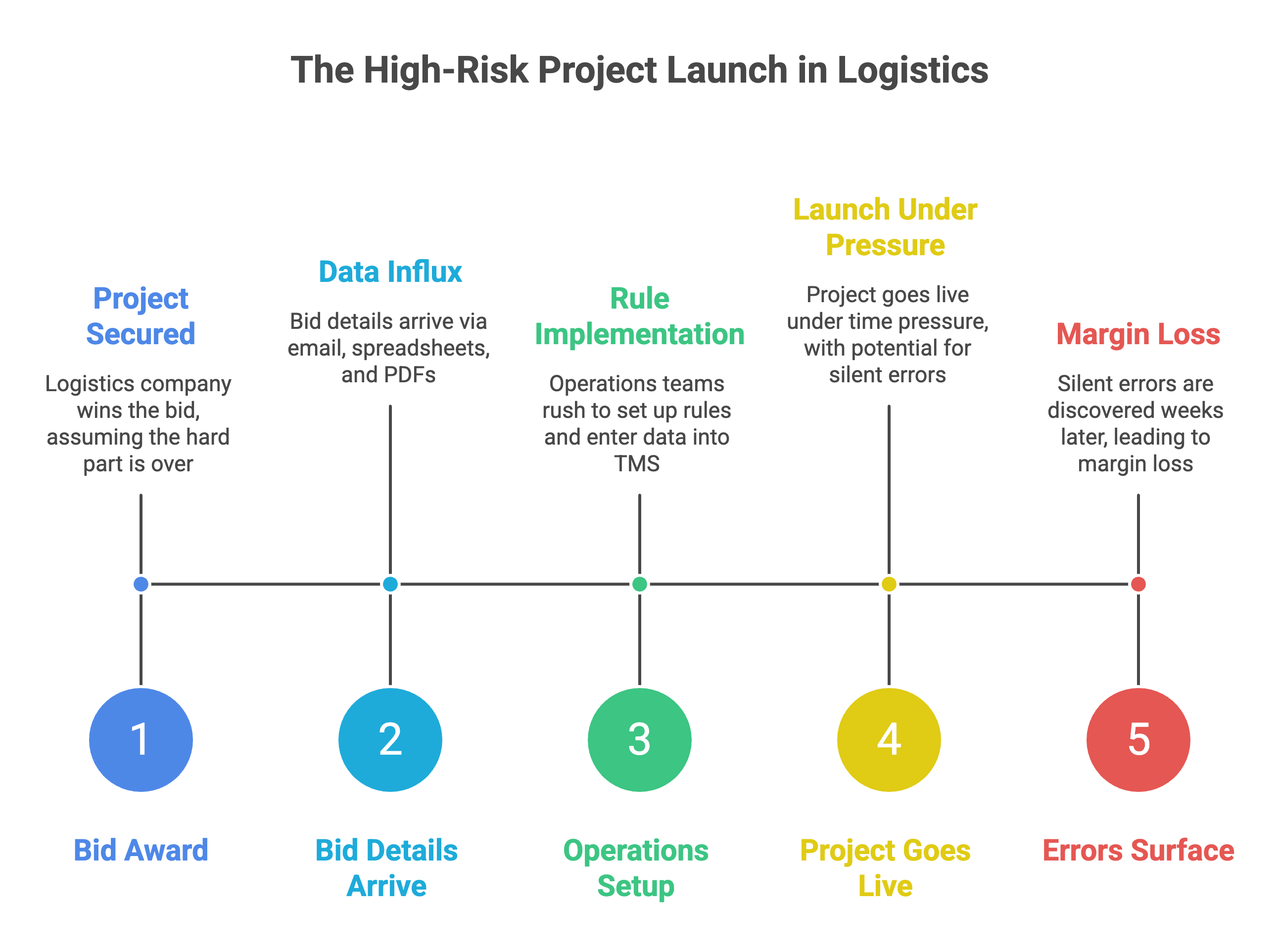
- Bid details arrive via email
- Operations teams rush to set up rules
- Data is manually entered into the TMS
- The project goes live under time pressure
This is where silent errors are born.
2. The Hidden Cost of Manual TMS Setup
Project shipment bids typically include:
- Multiple lanes
- Special pricing rules
- Volume commitments
- Start and end dates
- Unique accessorial terms
These details rarely arrive cleanly.
They arrive as:
- Email bodies
- Spreadsheets
- PDFs
- Forwarded threads
Operations teams must interpret all of this and translate it into system logic.
Common errors that follow
- Wrong effective dates
- Missing accessorial exceptions
- Rates applied to incorrect lanes
- Project rules overwritten by standard pricing
None of these are immediately obvious.
They only surface weeks later—as margin loss.
3. Why Traditional Fixes Don’t Work
Logistics companies try to solve this with:
- Checklists
- Double reviews
- Senior sign-offs
These slow things down—but don’t eliminate risk.
Why?
Because humans are being asked to:
- Interpret unstructured text
- Apply complex rules
- Move fast under pressure
This is not a discipline problem.
It is a system design problem.
4. What AI Bid-to-TMS Automation Actually Is
An AI Bid-to-TMS Automation Bot is a system that:
- Reads bid-related emails and attachments
- Understands whether a bid was won or lost
- Extracts structured shipment data
- Validates completeness
- Automatically creates or updates TMS project rules
It does not “guess.”
It enforces consistency and completeness.
5. How the AI Works (Step-by-Step)
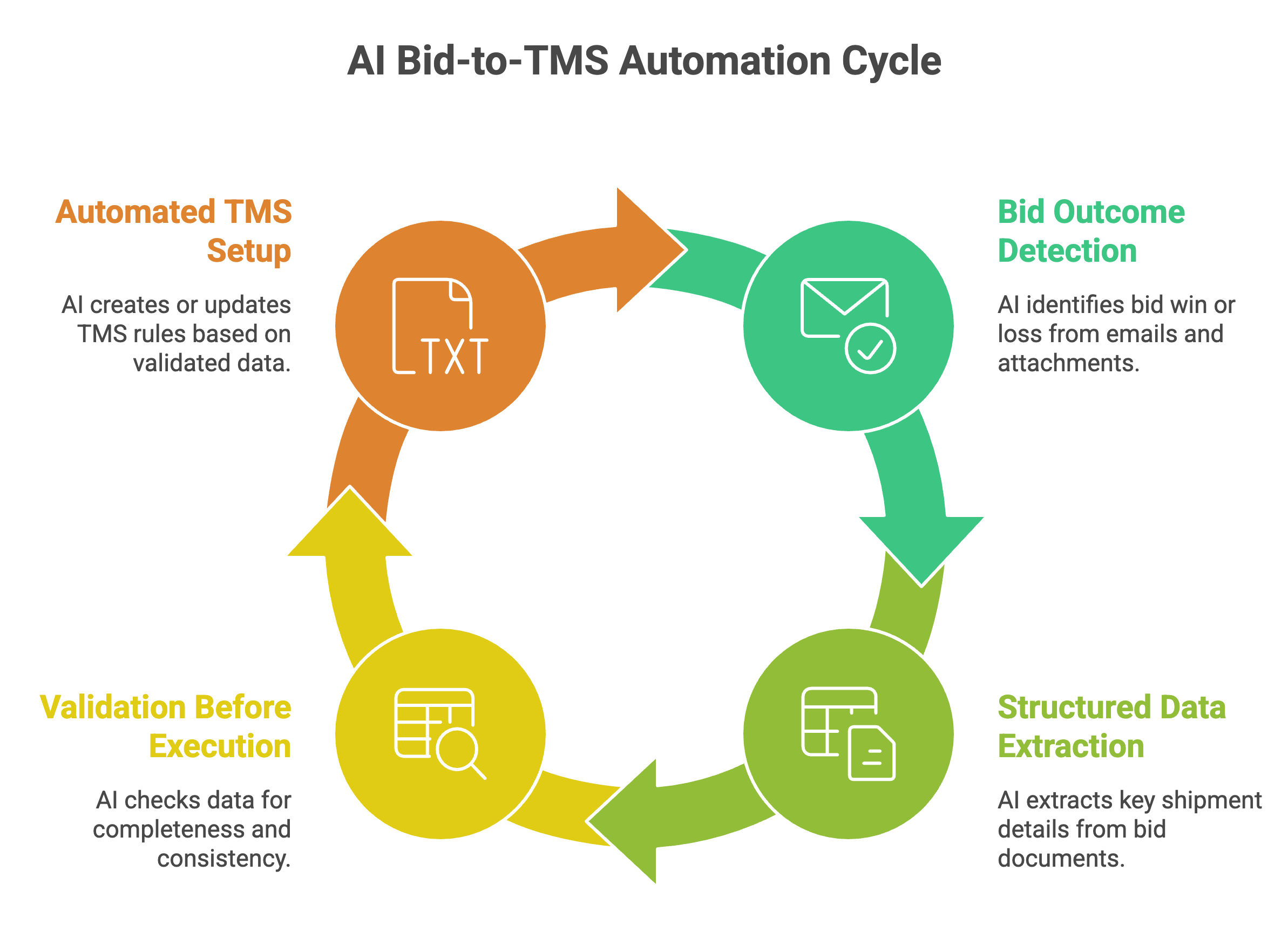
Step 1: Bid outcome detection
When an email arrives, AI evaluates:
- Language indicating win or loss
- Attachments with award confirmation
- Referenced rate sheets or project IDs
The system classifies the outcome without human input.
Step 2: Structured data extraction
If the bid is won, AI extracts:
- Origin–destination pairs
- Rates and pricing models
- Volume commitments
- Effective and expiration dates
- Accessorial exceptions
Unstructured content becomes structured inputs.
Step 3: Validation before execution
Before pushing data to the TMS, AI checks:
- Are all required fields present?
- Do dates overlap with existing pricing?
- Are accessorials defined consistently?
- Are any lanes missing rates?
If something is unclear, it flags it before setup, not after go-live.
Step 4: Automated TMS setup
Once validated:
- Project-specific rules are created in the TMS
- Overrides are applied correctly
- Effective dates are enforced
- Pricing logic matches the bid exactly
This eliminates manual rekeying entirely.
Free Session with Our Head of AI
30-Minute, no-strings-attached brainstorming session to identify potential bottlenecks and explore how AI can solve your business challenge.
Book Now →.png)
6. End-to-End Example: What Changes in Practice
Without AI (common reality)
- Bid win email arrives Friday afternoon
- Ops scrambles to interpret details
- Project setup completed under time pressure
- First invoices show discrepancies weeks later
- Margin loss traced back to setup errors
The bid was priced correctly.
Execution was not.
With AI Automation
- Bid win email arrives
- AI extracts and validates all details
- TMS setup completed automatically
- Project goes live cleanly
- Pricing and execution stay aligned
No rush.
No guesswork.
7. Before vs After: The Difference Is Structural

The biggest shift isn’t efficiency—it’s reliability.
8. KPIs That Improve Immediately
Organizations deploying AI here see:
- Less Setup-related billing errors
- Less Post-project margin corrections
- Fast Time-to-project-launch
- More Confidence in bid profitability
But the most important KPI is this:
Bid margin realized vs bid margin planned
AI closes that gap.
9. Who Needs This the Most
This use case delivers the highest ROI for:
- 3PLs running frequent project bids
- Freight brokers handling RFP-style awards
- Logistics teams onboarding time-sensitive customers
- Ops teams stretched thin
If your team says:
“We won the deal, but execution was messy”
This is built for you.
10. Common Objections (Answered)
“We haven’t had many issues”
You’ve had them.
They just showed up as margin leakage, not alerts.
“This sounds complex to implement”
It’s easier than enforcing perfect human discipline at scale.
“Ops likes control”
AI doesn’t remove control.
It removes preventable mistakes.
11. The Bigger Picture: Margin Is Lost After the Sale
Most logistics margin loss happens:
- Not during pricing
- Not during negotiation
But during execution setup.
AI ensures that what was promised is exactly what gets executed—every time.
Free Session with Our Head of AI
30-Minute, no-strings-attached brainstorming session to identify potential bottlenecks and explore how AI can solve your business challenge.
Book Now →
Final Takeaway
Winning shipment bids is easy compared to executing them perfectly at scale.
AI doesn’t help you win more bids.
It helps you keep the margin from the ones you already win.
And in logistics, that’s where the real money is.
Our team helps high-volume logistics organizations reduce execution errors and prevent billing leakage using AI.
If AI implementation is on your radar this year, check out how we can help and other high ROI use cases and case studies here: https://symphonize.com/logistics-ai


.png)
.png)

.png)


Christian Financial Credit Union
Huntington National Bank
Paqqets
Meridian Medical Management
Thales Group
Meridian Medical Management