


Most logistics escalations don’t start with angry calls — they start with an email that doesn’t get answered fast enough.
Shared inboxes, unclear ownership, and rising volumes make silence the biggest operational risk.
This article explains how AI email monitoring and escalation bots identify risk early, enforce response SLAs, and surface problems before customers escalate or trust is damaged.
Free Session with Our Head of AI
30-Minute, no-strings-attached brainstorming session to identify potential bottlenecks and explore how AI can solve your business challenge.
Book Now →.png)
If issues in your business “suddenly escalate” without warning, this blog explains why—and how AI stops that from happening.
1. The Most Dangerous Problems in Logistics Start Quietly
Logistics failures rarely begin with phone calls from executives.
They begin with:
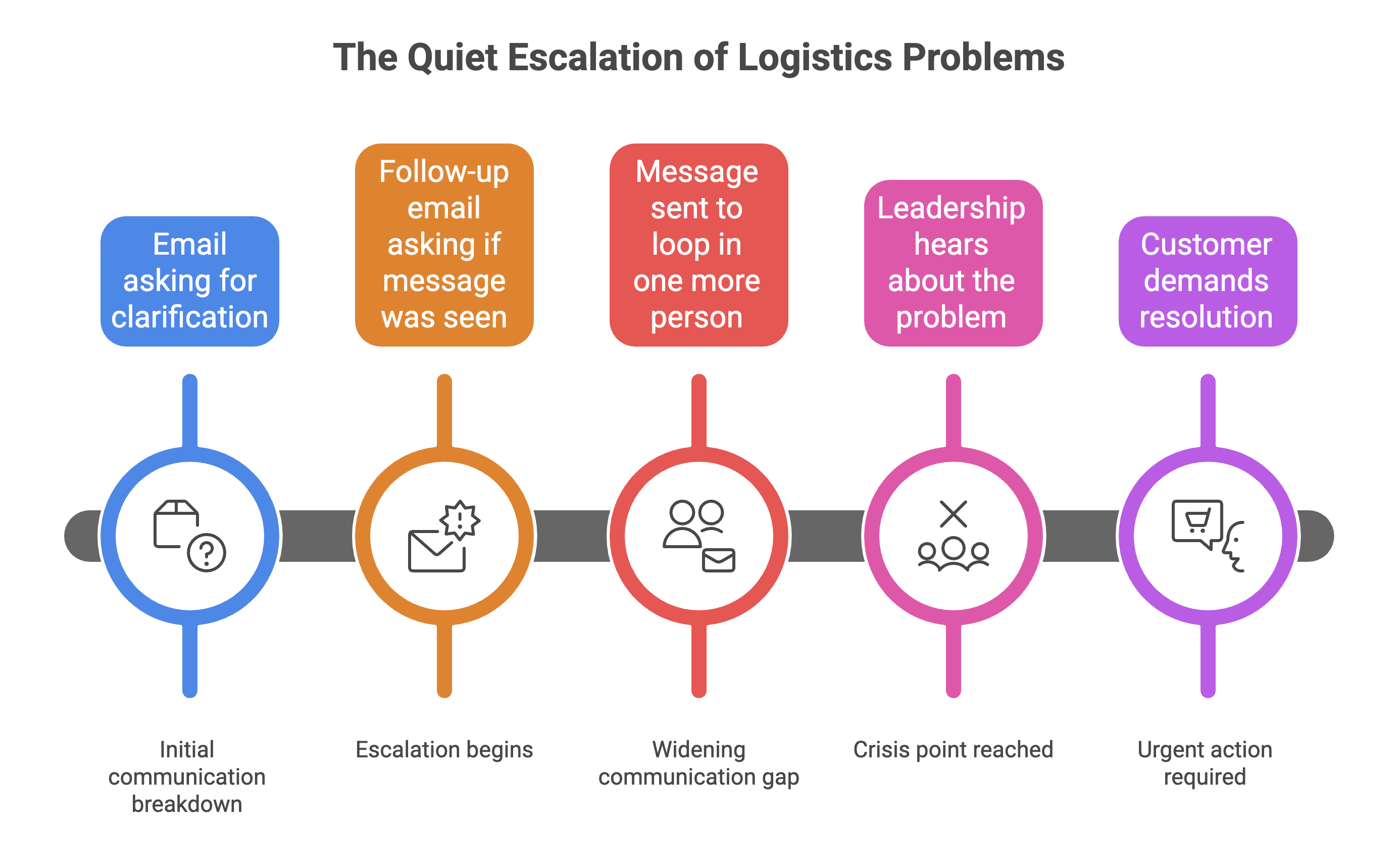
- A short email asking for clarification
- A follow-up asking if anyone saw the last message
- A message sent to “just loop in one more person”
By the time leadership hears about it, the customer is no longer asking—they are demanding.
This is not an email problem.
This is a visibility problem.
2. Why Email Is Still a Single Point of Failure
Despite modern systems, most logistics communication still flows through email.
Especially:
- Billing disputes
- Carrier accessorial clarifications
- Project shipment coordination
- Customer SLA issues
Why emails are uniquely risky
- No inherent prioritization
- Urgency is implied, not labeled
- Ownership is ambiguous
- Shared inboxes dilute responsibility
Humans are forced to interpret urgency under load.
That’s where things break.
3. Why Traditional Fixes Don’t Work
Most companies respond to missed emails by:
- Adding SLAs
- Creating escalation email addresses
- Asking teams to “monitor inboxes closely”
These fail because:
- Rules don’t understand intent
- Humans miss context under pressure
- Volume makes discipline impossible
What’s missing is continuous interpretation.
4. What an AI Email Monitoring & Escalation Bot Actually Is
An AI Email Monitoring Bot is not a filter or autoresponder.
It is a system that:
- Reads emails the way humans do
- Understands tone, repetition, and risk
- Tracks response behavior in real time
- Forces visibility when silence becomes dangerous
It does not wait for someone to complain.
It surfaces risk early.
5. How the AI Escalation Bot Works (System View)
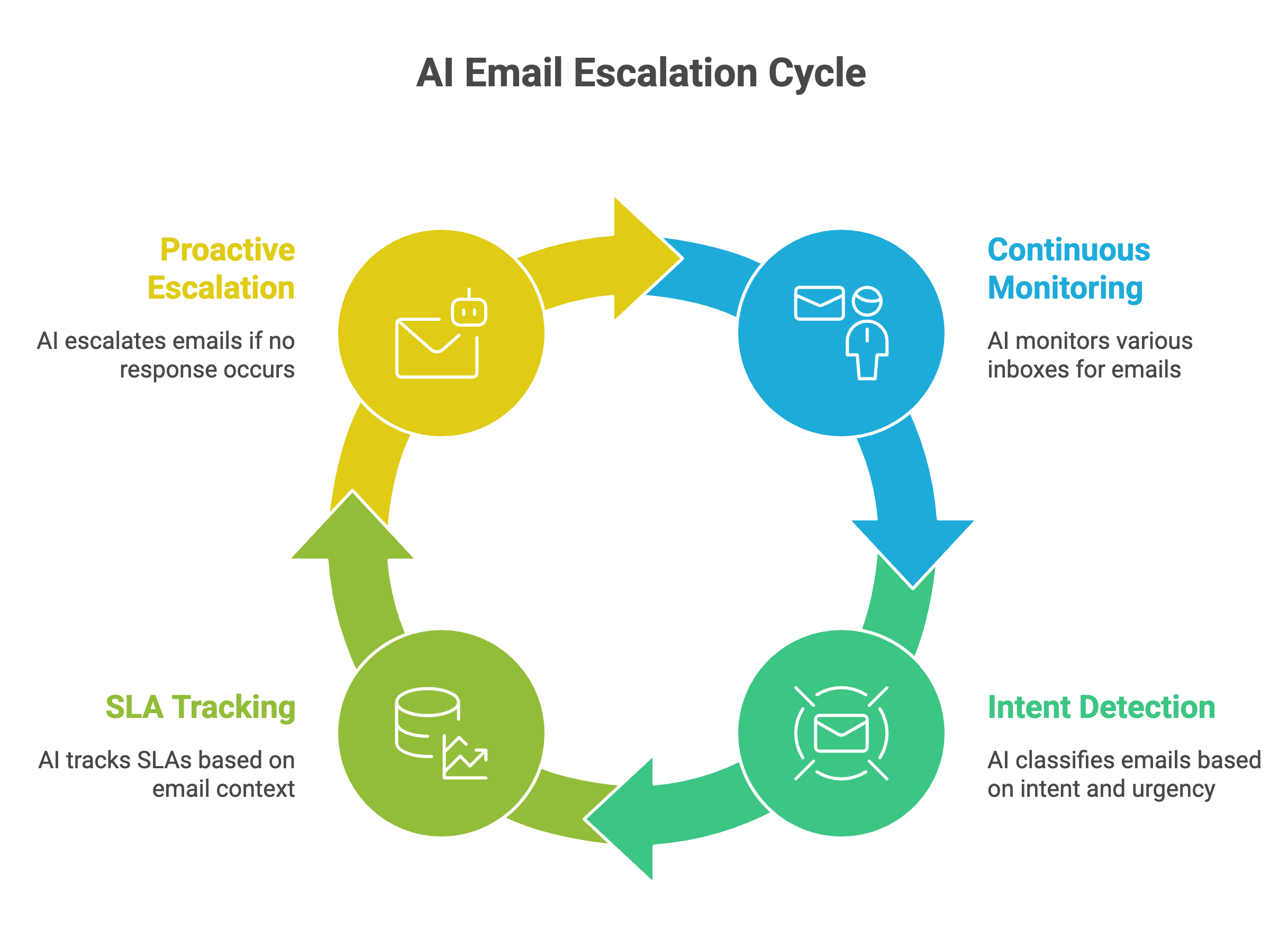
Step 1: Continuous inbox monitoring
The AI monitors:
- AP inboxes
- Operations inboxes
- Customer service mailboxes
It reads:
- Subject lines
- Message bodies
- Reply chains
- Frequency and timing of follow-ups
Step 2: Intent and urgency detection
AI classifies messages as:
- Informational
- Action-required
- Escalation-risk
Indicators include:
- Repeated follow-ups
- Language signaling frustration
- Deadline references
- SLA-related wording
This goes far beyond keyword rules.
Step 3: SLA tracking by context
Instead of one global SLA, AI applies:
- Short SLAs to high-risk emails
- Longer SLAs to low-risk ones
Silence is measured against intent, not time alone.
Step 4: Proactive escalation
If no response occurs within the risk-based window:
- AI pushes an alert to Microsoft Teams
- Includes:
- Email summary
- Escalation score
- Suggested owner
This happens before customers escalate externally.
Free Session with Our Head of AI
30-Minute, no-strings-attached brainstorming session to identify potential bottlenecks and explore how AI can solve your business challenge.
Book Now →
6. A Realistic Operational Example
The initial email
A customer emails AP:
“We’re seeing an unexplained accessorial charge again. Please advise.”
AI flags: Action-required.
The follow-up
Two hours later:
“Following up—this is impacting our month-end reconciliation.”
AI detects:
- Repetition
- Financial impact language
Escalation score increases.
The silence
No response for 30 minutes.
AI triggers a Teams message:
“High-risk customer billing email pending response (32 minutes). Customer has followed up twice.”
Leadership and ops see it immediately.
Issue is addressed same day.
7. Before vs After: Visibility Changes Everything

The biggest change is not speed—it’s predictability.
8. KPIs That Improve with AI Monitoring
- Less Unplanned escalations
- Less SLA breaches
- Increased first-response adherence
- Increased Customer retention
But there’s a subtler KPI that matters:
Escalations prevented, not resolved
That number matters more than any response-time metric.
9. Who Should Deploy This First
AI email monitoring delivers maximum value for:
- Logistics firms with shared inboxes
- Teams handling disputes or billing issues
- Organizations serving enterprise customers
- High-volume email environments
If your leaders say:
“Why am I hearing about this now?”
You need this.
10. Common Objections (and the Reality)
“Our team is responsive”
Responsiveness isn’t the problem.
Consistency under pressure is.
“We already have escalation rules”
Rules escalate too late.
AI escalates when risk starts—not after damage.
“This feels like surveillance”
It monitors risk, not people.
And it protects teams from unfair blame.
11. The Bigger Shift: From Inbox Management to Trust Infrastructure
Email monitoring isn’t about speed.
It’s about organizational reliability.
AI ensures that silence never becomes:
- Negligence
- Miscommunication
- Lost customers
Silence becomes visible—and visibility changes behavior.
Free Session with Our Head of AI
30-Minute, no-strings-attached brainstorming session to identify potential bottlenecks and explore how AI can solve your business challenge.
Book Now →
Final Takeaway
Logistics companies don’t lose customers because of mistakes.
They lose customers because of missed moments to respond.
AI Email Monitoring Bots ensure those moments never slip through unnoticed.
Our team helps high-volume logistics organizations reduce execution errors and prevent billing leakage using AI.
If AI implementation is on your radar this year, check out how we can help and other high ROI use cases and case studies here: https://symphonize.com/logistics-ai


.png)

.png)
.png)


Christian Financial Credit Union
Huntington National Bank
Paqqets
Meridian Medical Management
Thales Group
Meridian Medical Management