


Assigning drivers to routes sounds simple. It isn’t.
When assignments are based on distance alone, or dispatcher familiarity, hidden variables compound:
Driver availability
HOS constraints
Traffic volatility
Customer SLAs
Equipment compatibility
Route risk
Fatigue exposure
Small inefficiencies repeat daily.
Across fleets, 3PLs, last-mile operators, and enterprise trucking networks, those small inefficiencies quietly erode:
Margins
Service reliability
Driver satisfaction
This article explains how AI-powered driver-route assignment engines evaluate operational, financial, and human variables simultaneously turning dispatch from reactive judgment into structured precision.
1. The Hidden Cost of Manual Driver Assignment
In most operations, driver assignment looks like this:
1. Dispatcher checks available drivers
2. Routes are sorted by urgency
3. Assignments are made based on proximity and familiarity
On paper, it works.
In practice:
- The same drivers get overloaded
- High-risk routes concentrate with certain carriers
- HOS violations hover near thresholds
- Empty miles expand quietly
- Service variability increases
Dispatchers are not underperforming. They are overloaded decision engines operating on incomplete signal.
Humans cannot reason across:
- Thousands of historical routes
- Driver behavior patterns
- Seasonal congestion shifts
- Fuel efficiency variability
- Service risk exposure
The system expects intuition to scale infinitely.
It doesn’t.
2. Why Traditional Dispatch Logic Breaks at Scale
Most assignment logic relies on:
1. Distance
2. Availability
3. Static route schedules
But routing risk is multi-dimensional.
Two drivers may both be 12 miles away.
Driver A:
Consistently performs well on congested urban routes.
Driver B:
Higher fuel burn, recent fatigue signals, slower load times.
Traditional systems treat them as equal.
They are not equal.
Manual assignment also fails to account for:
- Cumulative fatigue across weeks
- Historical on-time performance by lane
- Load-specific compatibility patterns
- Customer sensitivity tiers
Distance is not the risk variable, Predictability is.
3. What an AI-Powered Driver-Route Assignment Engine Actually Is
It is not a “smart dispatcher tool.”
It is a continuous optimization and risk evaluation layer that sits above:
TMS
Telematics systems
Driver HOS systems
Fleet management software
Historical load databases
It continuously analyzes:
Driver behavior patterns
Lane volatility
Delivery reliability
Fuel efficiency
Service risk exposure
Customer SLA sensitivity
And then recommends assignments that balance:
Margin
Reliability
Driver sustainability
Customer performance
It does not remove dispatchers.
It removes blind spots.
4. How the AI Assignment Engine Works (System-Level View)
Step 1: Continuous Driver Profiling
The AI models drivers across:
On-time performance
Lane familiarity
Urban vs highway strength
Fuel efficiency under load type
HOS pattern stress
Incident rates
Each driver develops a live performance profile.
Not just availability — capability.
Step 2: Route Risk Classification
Every route is classified by:
Volatility
Historical delay probability
Customer sensitivity
Load type complexity
Distance vs congestion ratio
Routes are not just miles.
They are risk clusters.
Step 3: Multi-Factor Matching
Instead of asking:
“Who is closest?”
The AI asks:
“Who maximizes reliability while minimizing risk and cost?”
It evaluates:
Driver-route compatibility
Fatigue trajectory across the week
Empty mile exposure
Fuel efficiency impact
Service performance probability
Assignments become probabilistic decisions, not linear ones.
Step 4: Continuous Rebalancing
If conditions change:
Traffic shifts
A delay occurs
A route is canceled
A driver approaches HOS limits
The system recalculates proactively, not reactively.
Free Session with Our Head of AI
30-Minute, no-strings-attached brainstorming session to identify potential bottlenecks and explore how AI can solve your business challenge.
Book Now →.png)
5. A Realistic Operational Example
A regional fleet runs 350 routes daily.
Manual logic assigns based on proximity and availability.
What AI reveals:
One driver cluster handles 62% of volatile routes
Urban routes produce higher service risk with newer drivers
Fuel burn increases 7% on specific load-driver combinations
High-margin customers experience inconsistent pairing
AI recommendations:
Redistribute volatile lanes to experienced congestion-tolerant drivers
Match fuel-efficient drivers to long-haul loads
Rotate fatigue exposure across driver groups
Protect high-SLA customers with reliability-weighted pairing
Within 90 days:
On-time delivery improves
Fuel waste decreases
Driver complaints decline
Dispatch stress drops
Not because routes changed.
Because assignment precision improved.
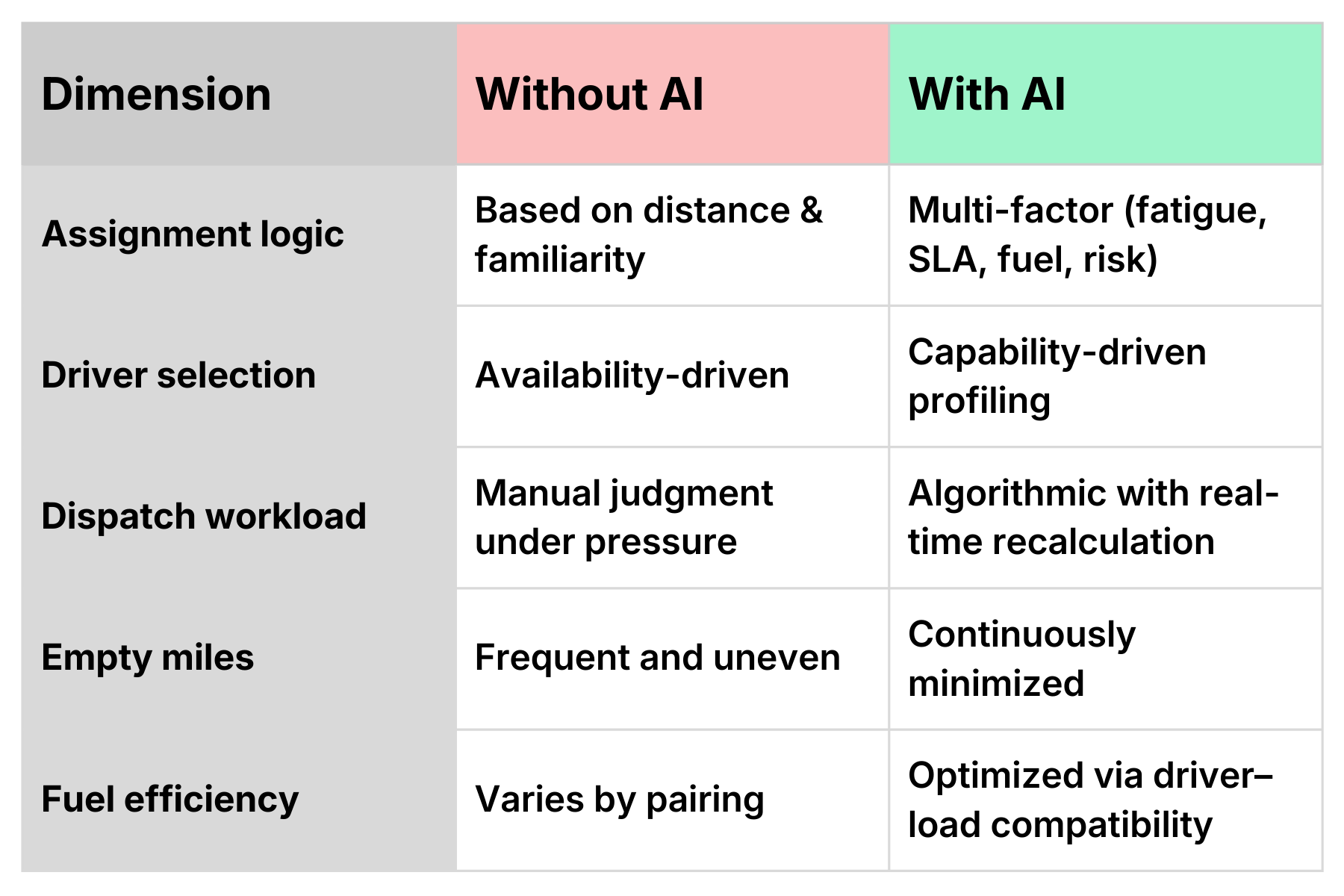
6. Before vs After: What Actually Changes
The biggest difference is not speed.
It’s consistency.
Dispatch stops being reactive problem-solving.
It becomes structured performance engineering.
7. KPIs That Move When AI Enters Driver Assignment
⬇ Empty miles
⬇ Service variability
⬇ Fuel inefficiency
⬇ Driver fatigue clusters
⬆ On-time percentage
⬆ Driver retention
⬆ SLA adherence
⬆ Route-level predictability
But one metric matters most:
Assignment precision per route.
Precision compounds.
8. Who Should Deploy AI Assignment Engines First
Highest ROI environments:
Multi-terminal fleets
3PLs with mixed contracted and owned capacity
Last-mile networks under SLA pressure
Enterprise trucking with high route variability
If dispatch feels overloaded, political, or inconsistent — this is the leverage layer.
Free Session with Our Head of AI
30-Minute, no-strings-attached brainstorming session to identify potential bottlenecks and explore how AI can solve your business challenge.
Book Now →
9. Common Objections (and the Reality)
“We already use routing software.”
Routing software finds paths.
AI assignment evaluates risk and human variability.
Different layer.
“Our dispatchers know the drivers.”
They do.
But they cannot calculate volatility across 24 months of route history in real time.
“This feels complex.”
Complexity already exists.
AI simply makes it visible and manageable.
10. The Bigger Shift: Dispatch as Strategy, Not Scheduling
Manual dispatch treats assignment as a daily task.
AI turns assignment into:
A margin lever
A safety control
A retention tool
A reliability engine
The competitive advantage is not cheaper lanes.
It is predictable execution.
And in logistics, predictability beats speed every time.


.png)


.png)


Christian Financial Credit Union
Huntington National Bank
Paqqets
Meridian Medical Management
Thales Group
Meridian Medical Management